
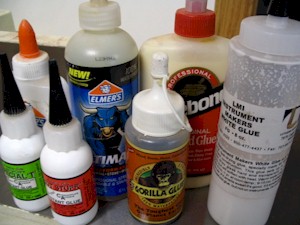
Not all glues that are popular for woodworking are necessarily the best for instrument making, and especially making a bowed psaltery. The objectives and goals are slightly different in the two situations; while it’s true that in both instances the goal is to stick two pieces of wood together, some other questions arise:
- Was this glue designed to withstand several hundred pounds of continuous pressure pulling against the joint?
- Will this glue come apart when exposed to high heat (as in the inside of a hot car)?
I think you get the picture. While there have been all sorts of advances made in woodworking glues for making things like furniture and crafts, (IE – water resistance, extended open-time, and colored glues), many of these very same specialty glues are among the worst for making musical instruments.
One of the most important factors in musical instrument building, and psalteries specifically, is creep resistance. That is to say: creep is a glue’s tendency to slowly pull apart when put under a continuous load, as is the case with a bowed psaltery.
So with exterior and waterproof wood glues, (like Titebond II and Titebond III), which are great for building furniture, their special water-resistance and other attributes frequently come at the cost of creep resistance. Supposedly, chemicals added to the glue can inhibit them from fully hardening, and this therefore decreases their strength when put under a constant load.
Just what glues can/should be used for building a bowed psaltery?
Well, in all honesty, you can really use just about any/all types of glues, even ones like Titebond, with varying degrees of success. A lot will depend on how well you have joined the frame and top/bottom together. Some glues are more forgiving than others at filling small gaps between the pieces to be joined. (When I rate how good a glue is at gap filling, I’m not rating how good it is at simply filling in the gap, but how much strength it is actually able to impart when bridging that gap. It has nothing to do with aesthetics and everything to do with strength.)
Nonetheless, using the right kind of glue (and understanding how to use it properly) can go a long way in increasing the strength and longevity of your psaltery. Some glues that I’ve either used personally, or have heard to be good in regards to creep resistance are:
-
Polyurethane-based glues (Gorilla glue, Ultimate glue, etc.) – Widely available at most hardware and woodworking stores. It is critical that you moisten both surfaces of the wood with water just before gluing; this moisture activates the glue. Also, polyurethane glue expands as it cures, so you need to have the pieces firmly clamped together or they may move apart during the curing process. The curing process takes several hours, so plan on leaving the clamps on for the better part of the day. This glue is not good at filling gaps at all, so you must take care to ensure that your joints fit together snugly when using this glue. On the upside, polyurethane glues are virtually impervious to heat, moisture, and creep.
(Note: polyurethane was the type of glue used to build the psaltery for this project.)
-
2-part epoxy glues (System Three, West System, etc.) – Available at woodworking stores like Rockler and Woodcraft, (check for local stores near you), as well as most hobby stores. Epoxy requires you to mix two components: the resin and the hardener, in a prescribed ratio. If mixed and applied properly, epoxy is an excellent choice for instruments, but try to avoid the 5-minute variety. (It seems that whenever a glue is “new and improved,” as with the 5-minute variety of epoxy, all of the desirable attributes for musical instrument construction are compromised.) One of the only problems that could arise with epoxy is if the mixing ratio and application instructions aren’t followed. Provided you use high-quality woodworker’s epoxy, this glue is probably the best choice for those who have less-than-desirable joinery work on the frame of their psaltery as it is excellent in filling gaps. However, epoxy can be relatively expensive, (for a glue), though this may be partly due to the fact that epoxy is generally sold in large quantities.
-
Hot hide glue (granular glue dissolved in hot water) – Available at woodworking stores like Rockler and Woodcraft, (check for local stores near you), as well as some online and specialty stores. Probably the best glue for creep resistance, and widely used by luthiers. Hide glue requires you to dissolve the glue in a double boiler glue pot full of hot water. One of the trademarks of this glue is that it is reversible with heat/humidity – a handy feature for builders of guitars or violins when they need to pop the top off and adjust something inside the instrument – though this is not something that is of much value on a bowed psaltery, as there are scores of pins and strings in the top, and in my opinion, should be constructed permanently. For everything that you ever wanted to know about hide glue, visit the page on hide glue at frets.com. I wouldn’t recommend hide glue to beginners because it requires more experience to use properly, and is not good at filling gaps in joinery. (Can you say, “catastrophic implosion”?)
-
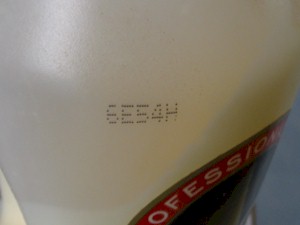
Titebond Original (sometimes called “yellow glue”) – This is the most common glue used by many woodworkers. It is widely available at hardware and woodworking stores. You can also use any other yellow glue like Elmer’s, as long as it is interior wood glue. Plain, ordinary wood glue, with no fancy additives. The plainer, the better! Yellow glue can still creep, but can be used if you don’t feel comfortable with any of the other glues listed above. A lot will depend on how good your joinery has been. I specifically use the Titebond brand glue for various tasks (except gluing frames) because it is the most trusted and reliable among the woodworkers that I have talked to. Also, it has a date code printed on the back to let you know how old the glue is – I wouldn’t use glue for musical instruments if it is more than 9 to 12 months old. (The date code is the first two digits of the code printed on the side of the bottle. The number is the year, and the letter is the month, A-M, skipping the letter I because it resembles the number 1.)
-
Luthier’s Mercantile International Instrument Glue – This is just another formulation of wood glue, though it is held in high regard among instrument builders. As I understand it, this glue supposedly does not contain the yellow dye found in other wood glues, (it’s actually white), and is therefore purer and dries harder than standard wood glue. In theory then, it should be more resistant to creep, though it still won’t hold up as well as the glues listed at the top of this list. This glue can only be found from one source: the Luthier’s Mercantile International website. LMI is a useful company, and if you ever find yourself ordering supplies for making your bowed psaltery, it might be a good idea to tack on a bottle of their glue too.
-
Cyanoacrylate glues (Hot Stuff, USA Gold, etc.) – Available in some hardware stores as “Super glue” or “Krazy glue,” but most higher quality types are only found in woodworking and hobby stores. To be honest, I only use Cyanoacrylate (abbreviated CA) glues for gluing small things like inlays and decorations. I don’t have any experience with this glue in terms of structural gluing of an instrument, but supposedly it has very good creep resistance. If you are a woodworker who has a decent amount of experience with this type of glue, it may be worth your while to try it; though I can’t really comment much on CA glues for this application.
I hope this section has helped inform you as to the many choices of glues for making your “psimple psaltery.” The heart of the matter is this: use good joinery – to the best of your abilities. Don’t rush through things. And, if you still can’t get the joints perfect, at the very least read and follow the manufacturer’s instructions carefully for any of the glues – you don’t want to compound the problem! Epoxy will do the best job in making up for deficiencies in joinery, but nothing can bail you out of complete sloppiness.
One last thing that you can consider if you’ve glued your frame together, and you’re worried about its long-term integrity is to use lighter gauge strings to minimize the pull on the frame.
In my opinion, there really is no one perfect glue, but each person uses what works best for their situation. I hope I’ve given you a balanced look at all the options as they pertain to the bowed psaltery.
Many thanks for putting it all together. Half-way there. only change is to add dowels pinning sides to pinblock.